
On August 7, 2026, the Uttarakhand Cabinet, chaired by Chief Minister Pushkar Singh Dhami, cleared 15 decisions spanning labour rules, industrial relations, judicial infrastructure, and rural livelihoods. Among them was a change with direct relevance to dairy: a significant expansion of the state’s cattle rearing subsidy scheme.
For a hill state where dairy farming is a major rural livelihood, more animals in farmers’ hands raises an obvious question: is the state’s collection, chilling, and processing infrastructure ready for what comes next?
What Has Uttarakhand Actually Announced?
According to officials who briefed the press after the Cabinet meeting, the State Sector Cattle Rearing Scheme has been widened to include general category farmers, who were previously outside its scope. Beneficiaries can now also opt to purchase buffaloes, not just cows, and the unit cost used to calculate the subsidy has been raised from ₹40,000 to ₹60,000 per animal.
SC/ST beneficiaries remain eligible for up to 90 percent subsidy, while general category beneficiaries can receive up to 60 percent. The scheme is expected to benefit around 2,128 farmers in its first year, aimed at strengthening rural incomes and self-employment.
It’s worth being precise: this is a livestock ownership subsidy, not a dairy infrastructure package. The remaining 14 decisions from the same meeting — new Wage Code and Industrial Relations rules, the Ganga Expressway extension, a Haldwani High Court complex — sit outside the dairy sector.
Why This Matters for Milk Production
Uttarakhand’s dairy sector has been growing steadily. The state’s dairy development minister told the assembly earlier this year that milk production had risen about 3.1 percent year-on-year, from roughly 1,897.8 to 1,957.2 thousand tonnes, with per-capita daily availability at 456 grams against a national average near 485 grams. Daily production (about 53.6 lakh kg) and consumption (about 50.3 lakh kg) are nearly balanced.
A scheme that brings more farmers into livestock ownership, and lets existing ones add buffaloes, could support continued growth over time — though the effect isn’t immediate, since new herds take time to calve and reach full lactation. The scheme itself doesn’t determine where the extra milk will go.
For Any Query, Please Fill Out the Form Below
More Milk Needs More Than More Cows
An increase in animals only becomes sellable milk if the surrounding infrastructure can move it from farm to consumer without spoiling it — through village-level collection, quality testing, rapid chilling, transport, processing, storage, and ongoing quality control. This is precisely the gap that national programmes like the National Programme for Dairy Development (NPDD) and NABARD’s Dairy Processing and Infrastructure Development Fund (DIDF) are designed to close, by funding testing equipment and primary chilling facilities for cooperatives and processors. A livestock push works best alongside continued investment in this connecting infrastructure, not instead of it.
The Hill State Complication
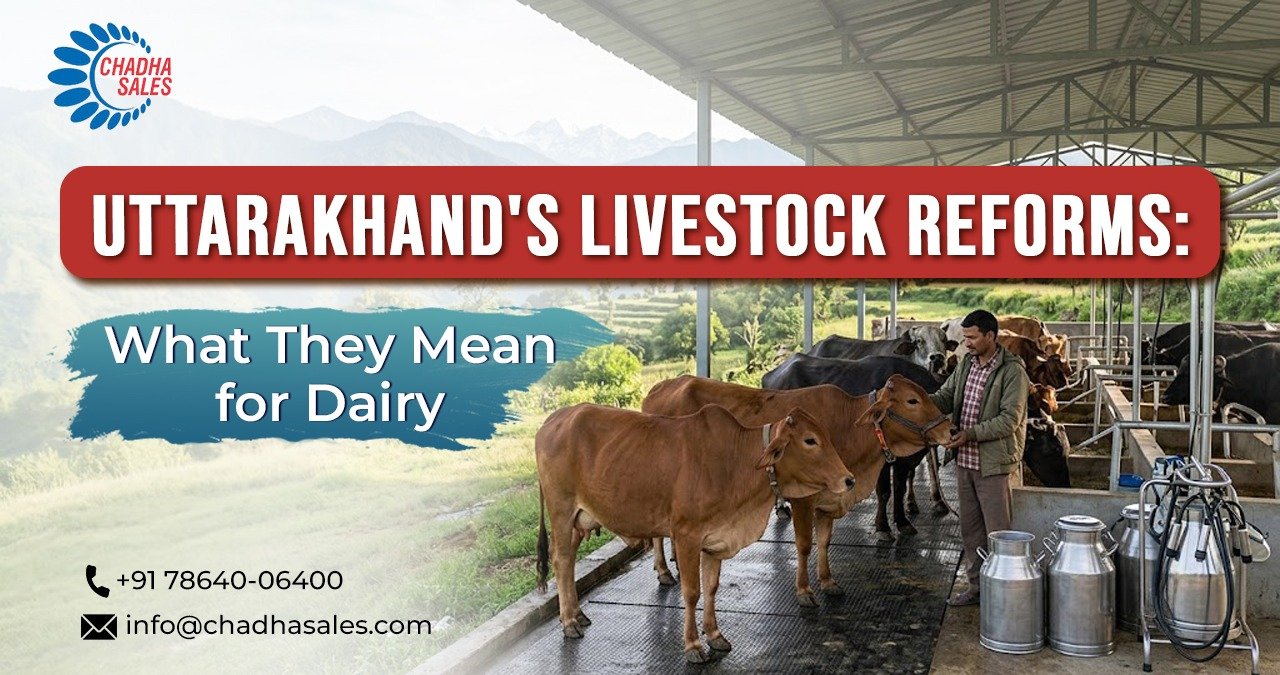
Uttarakhand’s dairy geography makes this harder than in a flat, densely farmed state. Herds are typically small and spread across dispersed hillside villages, and collected milk often travels a considerable distance over hill roads — sometimes several tens of kilometres — before reaching a processing unit.
Every extra hour between milking and chilling raises spoilage risk, and unreliable rural power compounds it: studies of India’s dairy cold chain put losses from erratic electricity at roughly 3 percent, since chilling itself consumes a large share of a collection centre’s energy use. In terrain like this, chilling infrastructure placed close to the point of collection matters more than in flatter, more centralised dairy regions.
What This Could Open Up for Dairy Entrepreneurs
More general-category farmers entering organised dairy farming could widen demand for collection infrastructure in underserved areas. Uttarakhand already runs close to 2,830 milk cooperative societies under the Aanchal brand, but there’s room for both cooperative expansion and private players in pockets those societies don’t reach.
There may also be an opening for small-scale processing closer to production clusters — village-level paneer, khoa, or ghee units that convert milk into a value-added, less perishable product near the source rather than transporting it long distances raw. Women-led dairy micro-enterprises, already supported by the state cooperative federation, could suit this decentralised model well.
What Dairy Businesses Should Prepare For
- New and existing farmers should confirm a nearby cooperative society or private collection point before scaling herd size, so additional milk has somewhere to go.
- Cooperatives and processors in districts likely to see herd growth should assess current chilling and testing capacity before bottlenecks appear.
- Entrepreneurs planning a collection centre, chilling point, or small processing unit can look at combining this state subsidy with central schemes — PMFME’s 35 percent credit-linked capital subsidy (up to ₹10 lakh) for micro food processing units, or NABARD-linked support for bulk milk coolers and testers.
- Quality control matters more, not less, as smaller, newer producers enter the formal supply chain — accurate testing at the collection point keeps a growing farmer base aligned with FSSAI norms.
Building the Infrastructure Behind the Numbers
Livestock subsidies put more animals on the ground, but a stronger dairy economy depends on what happens after the milking pail — testing, chilling, transporting, and processing it reliably. Chadha Sales Pvt. Ltd., an ISO 9001:2015-certified manufacturer of dairy processing equipment, works with cooperatives, entrepreneurs, and processors on exactly this stretch of the value chain, from bulk milk coolers and milk analysers to paneer processing lines and milk collection systems.
If your organisation is planning to expand collection, add chilling capacity, or move into processing as milk volumes grow, our team can help you think through the right equipment for your scale and terrain.
FAQs
- What did the Uttarakhand Cabinet approve for livestock owners in August 2026?
It expanded the State Sector Cattle Rearing Scheme to include general category farmers (previously limited to SC/ST beneficiaries), added an option to purchase buffaloes alongside cows, and raised the per-animal unit cost from ₹40,000 to ₹60,000. - How much subsidy do farmers get under Uttarakhand’s revised cattle rearing scheme?
SC/ST beneficiaries can receive up to 90 percent subsidy on the unit cost, while general category beneficiaries can receive up to 60 percent, based on official statements after the Cabinet meeting. - Will Uttarakhand’s livestock reforms directly increase milk production?
The scheme could support gradual growth in milk output as herds expand, but the effect isn’t immediate, and it depends on farmers having functioning collection, chilling, and processing options for the extra milk they produce. - Why is decentralised milk chilling especially important in a state like Uttarakhand?
Uttarakhand’s dairy farms are dispersed across hilly terrain, often far from processing units. Delays between milking and chilling raise spoilage risk, so chilling infrastructure placed close to collection points matters more than in flatter, more centralised dairy regions. - What equipment does a village-level milk collection centre typically need?
A functioning centre generally needs milk testing/analysing equipment to check quality at intake, a bulk milk cooler or chilling unit to bring milk down to safe storage temperature quickly, and milk cans or transport containers for onward movement to a processing unit. - Are there subsidies available for setting up a dairy processing unit in Uttarakhand?
Entrepreneurs can explore the central PMFME scheme, which offers a 35 percent credit-linked capital subsidy (up to ₹10 lakh) for micro food processing units, alongside NABARD-linked schemes that support dairy equipment purchases such as bulk milk coolers and milk testers. - How can a new dairy farmer benefit from these state and central schemes together?
Farmers or entrepreneurs typically register with a milk cooperative society or apply through the Animal Husbandry Department for the livestock subsidy, and separately apply through their bank or the PMFME/NABARD channels for equipment or processing unit financing.
Suggested Internal Links
- Bulk Milk Coolers (product page)
- Milk Analysers / Milk Testing Equipment (product page)
- Paneer Processing Equipment (product page)
- Milk Collection Systems & Milk Cans (product page)
- Existing blog: PMFME Scheme and Dairy Processing Subsidies
- Existing blog: FSSAI Mandatory Registration for Independent Milk Producers