
Walk through the lanes of Agra and you will find it everywhere — petha, the translucent, melt-in-the-mouth sweet that has been a part of India’s culinary heritage for centuries. But few people know the fascinating process that transforms a simple ash gourd (kumhra / petha kaddu) into this crystal-clear delicacy.
Even fewer know that petha manufacturing is one of the most promising food processing businesses in India today — with low raw material costs, long shelf life, and a market that’s rapidly expanding beyond Agra to the rest of the country and abroad.
Let’s walk through the process.
The Journey: Ash Gourd to Petha
1. Washing, Peeling & Cutting
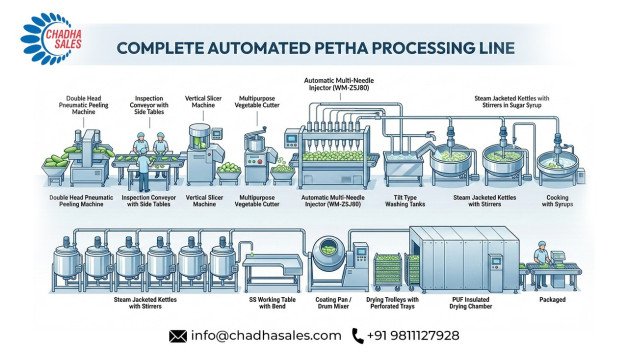
It starts with fresh ash gourds being thoroughly washed to remove dirt and field residue. The hard green skin is then peeled away, and the gourd is sliced into pieces. Seeds and the fibrous center are removed. The size and shape of the cut determines the final petha variety — cubes for classic white petha, thin slices for angoori petha, rectangular pieces for kesar petha.
2. Pricking (Gudai) — The Step That Makes All the Difference
This is the step most people don’t know about, and it’s arguably the most important one. Each piece is pricked with fine needles to create tiny channels throughout the flesh. These micro-holes are what allow sugar syrup to penetrate deep inside — without this, the syrup only coats the surface and you never get that signature translucent look.
Traditional halwais do this by hand with a fork or needle board. Modern production lines use automated pricking systems that can process hundreds of kilos per hour with perfect uniformity.
3. Lime Water Treatment (Chuna Pani)
The pricked pieces are soaked in a calcium hydroxide (chuna) solution for several hours. This ancient technique does something remarkable — the calcium ions react with pectin in the cell walls, creating a firm structure that holds its shape during cooking. Without this step, the pieces would simply dissolve into mush in the hot sugar syrup.
After soaking, the pieces are washed thoroughly to remove all traces of lime. Any residue left behind makes the petha bitter.
4. Sugar Syrup Cooking — Where the Magic Happens
This is where ash gourd becomes petha. The prepared pieces are slowly cooked in concentrated sugar syrup. As the temperature rises and the syrup reaches the right concentration, a process called osmotic dehydration takes place — the water inside the vegetable cells is gradually replaced by sugar. Piece by piece, the opaque white flesh turns glassy and translucent.
The skill lies in controlling the syrup concentration, temperature, and cooking time. Too much heat and the petha turns brown. Too little and it stays raw inside. This is where the right equipment and process knowledge make the difference between premium petha and average quality.
| The right cooking system can make or break your petha quality. We help you choose the exact setup for your capacity and budget. Talk to our process experts — no obligation, just clarity. ☎ +91-11-23922290 | ✉ salescoordinator@chadhasales.com |
5. Flavoring & Drying
Once cooked, the petha is drained and coated with flavoring essences — kewra (pandanus) for the classic white variety, saffron for kesar petha, rose water for gulab petha, and so on. The pieces are then dried under controlled conditions until the surface sugar crystallizes, giving white petha its characteristic bright appearance and slight crunch.
Proper drying is the final quality gate. Too fast and the surface cracks. Too slow and you get a sticky product with poor shelf life.
For Any Query, Please Fill Out the Form Below
Why Petha Is a Smart Business Bet
- Ash gourd is one of the cheapest vegetables in India — the value addition in petha is massive
- Unlike most Indian sweets, petha doesn’t need refrigeration and lasts 15–30 days
- Demand is growing rapidly beyond Agra — metros, tier-2 cities, and export markets
- Multiple product variants (white, kesar, angoori, paan, chocolate) allow premium pricing
- The same processing equipment can be used for murabba, gulkand, and other preserved foods
The challenge? Scaling from a manual halwai operation to a mechanized production line that delivers consistent quality at volume. That’s where the right equipment integration matters — and where most new entrants struggle.
From Small Batches to Industrial Scale — There’s a Solution for Every Level
Not every petha business needs the same setup. A sweet shop adding petha to its menu has very different needs from someone setting up a dedicated manufacturing unit for wholesale or export. The equipment, layout, capacity, and investment change significantly at each level.
| Starter / Sweet Shop Scale For existing sweet shops or new entrepreneurs testing the market. Semi-automatic with manual handling at some stages. Ideal for 100–200 kg per batch. |
| Medium / Commercial Scale For dedicated petha manufacturing units serving regional markets. Mechanized processing with minimal manual intervention. Designed for 200–300 kg per batch with room to grow. |
| Large / Industrial Scale For wholesale, institutional, or export-oriented operations. Fully integrated continuous processing lines handling 500+ kg per hour with complete automation. |
Each scale requires a different combination of machines, capacities, and process design. There is no one-size-fits-all solution — and choosing the wrong setup is an expensive mistake.
| Thinking About Starting a Petha Manufacturing Unit? Tell us your capacity requirement and budget range. Our team will design a complete solution — from process flow to equipment selection to installation. ☎ +91-11-23922290 / 23920100✉ salescoordinator@chadhasales.com 🌐 www.chadhasales.com ━━━━━━━━━━━━━━━━━━━━ CHADHA SALES PRIVATE LIMITED 137, Rajendra Market, Tiz Hazari, New Delhi – 110054 ISO 9001:2015 Certified | Turnkey Food Processing Solutions Since 1949 |