
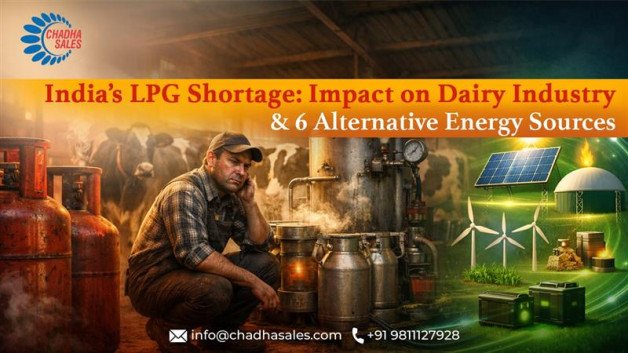
The lpg gas crisis in India is no longer just a headline — it’s hitting dairy operations hard, right now. If you run a dairy farm, a milk processing unit, or a chilling centre, you’re likely already feeling the pinch. Cylinders are scarce, commercial allocations have been slashed, and the question everyone in the industry is asking is: what do we do next?
At Chadha Sales, we’ve been serving the Indian dairy industry since 1948. We’re not just watching this crisis from the sidelines — our customers are calling us every day, looking for answers. This blog is our attempt to give the dairy industry clarity on what’s happening and, more importantly, what you can actually do about it.
What Is Causing the LPG Shortage in India?
The root cause is geopolitical. In early March 2026, a military conflict involving Iran, Israel, and the United States effectively closed the Strait of Hormuz — the maritime corridor through which roughly 90 percent of India’s LPG imports ordinarily travel. Weekly inflows fell an estimated 30 percent overnight.
India’s vulnerability here is structural. India imports about 60 percent of its LPG consumption, and out of these imports about 90 percent come through the Strait of Hormuz. On top of that, India has only 25–30 days of LPG strategic stock — compared to 60 days of crude oil — because LPG requires specialised high-pressure or cryogenic storage that is both expensive and limited.
When the government stepped in, it prioritised households. Commercial and industrial LPG was cut first. Restaurants, hotels, bakeries, dairies, and factories lost access before households. The result? In several states, non-essential sectors are receiving only 10 to 20% of their normal commercial LPG supply.
For Any Query, Please Fill Out the Form Below
How Is This Affecting the Dairy Industry?
The impact on dairy is serious and immediate.
LPG plays a key role in the dairy sector — it is widely used for pasteurization, the process of heating milk to a specific temperature to kill harmful bacteria and extend its shelf life. The shortage has made it increasingly difficult, particularly for small and medium-sized dairies, to carry out pasteurization at the scale required to handle large volumes of milk.
Gujarat — India’s biggest dairy state — has been hit especially hard. The state government slashed LPG supply to milk processing units by 40% to protect household cooking gas stocks. Gujarat’s dairy output is now running at just 60% capacity. This directly affects national brands and their downstream supply chains.
In Madhya Pradesh, the numbers are equally alarming. Disruptions have already cut milk processing capacity from 12–13 lakh litres per day down to nearly 8 lakh litres.
Industry representatives have warned that the crisis could escalate into a major issue within the next 10–12 days if gas supplies are not restored in time.
The bottom line: if your dairy still depends solely on LPG, you are running a serious operational risk.
6 Alternative Energy Sources Dairy Units Can Switch To Right Now
This crisis has made one thing clear — the dairy industry needs to diversify its energy sources. Here are the most practical options available today:
1. Piped Natural Gas (PNG)
PNG is the most direct LPG substitute for urban and peri-urban dairy operations. It is delivered directly through pipelines, meaning no cylinder dependency and no delivery delays.
PNG enquiries have jumped 20%, with 22,000 new users added in just 15 days — showing just how quickly the industry is moving in this direction. If your dairy is in a city or on the outskirts of a major town, check with your local gas distribution company (like IGL, MGL, or Adani Gas) for pipeline availability. PNG infrastructure is expanding rapidly.
Best for: Urban and semi-urban milk processing units, pasteurisation plants.
2. Electric / Induction-Based Heating
Electric cooking and heating have become significantly more cost-competitive. Electric cooking is already about 15–20 percent cheaper than LPG for many households and units, especially after recent increases in cylinder prices. Induction-based pasteurisers and boilers are now commercially available and offer precise temperature control — which is actually an advantage for dairy processing.
Induction stove sales have already surged amid fears of shortage, showing how quickly operations respond when reliability is threatened.
Best for: Small and medium dairies with reliable electricity supply, pasteurisation, and heating.
3. Biogas / Compressed Biogas (CBG)
Dairy farms are uniquely positioned to produce their own biogas — using cow dung, whey, and organic waste. This makes biogas one of the most self-reliant options available to the dairy industry.
States such as Kerala, Gujarat, and Maharashtra are increasingly adopting biogas as a practical alternative to LPG as the fuel crunch ripples through households and commercial kitchens. The government’s Compressed Biogas (SATAT) scheme also offers financial support for setting up biogas plants.
India currently has 195 compressed biogas plants being set up across the country.
Best for: Dairy farms with captive animal waste, rural processing units, cooperatives.
4. Solar Thermal Energy
Solar steam and solar thermal systems can directly replace LPG for heating milk and water in dairy operations. Projects in rural Gujarat range from solar-steam kitchens feeding thousands near Vadodara to solar-based cooking systems in villages near Anand. Solar thermal collectors can generate the temperatures required for pasteurisation in a cost-efficient and sustainable way.
Best for: Dairies in sunny regions (Rajasthan, Gujarat, UP, Haryana), large-scale processing units looking for long-term savings.
5. CNG (Compressed Natural Gas)
CNG is another viable alternative, especially for dairy units that already have CNG infrastructure nearby or that operate in cities with CNG networks. It burns cleaner than LPG and is slightly less vulnerable to the current supply disruption.
Note: CNG supply has also faced some rationing during the crisis, so it’s best used as a complement to other alternatives rather than a standalone replacement.
Best for: Processing plants in metro cities, units with existing CNG connections.
6. Biomass / Firewood (Short-Term Contingency Only)
This is the least desirable option but is being used as an emergency measure across parts of India. Since the shortage began, firewood has replaced gas connections in certain restaurants, hostels, and households. For dairy operations, biomass boilers can be a stop-gap measure but come with health and environmental concerns and are not recommended for long-term use.
Best for: Very short-term emergencies only, rural dairies with no other options immediately available.
What Should Dairy Operators Do Right Now?
Here’s a quick action checklist:
✅ Audit your current LPG dependency — identify which processes in your dairy use LPG and how much.
✅ Apply for PNG connection immediately if you’re in an area with pipeline access.
✅ Consult your electricity provider about load capacity for shifting to induction-based pasteurisation.
✅ Explore biogas feasibility — especially if you manage a herd of animals.
✅ Contact your equipment supplier about retrofitting or upgrading equipment to support alternative fuel sources.
How Chadha Sales Can Help
Incorporated in 1948, Chadha Sales Private Ltd is a pioneering company in the field of dairy processing equipment and milk processing plants. For over seven decades, we have helped dairy operators — from small farms to large cooperatives — navigate every kind of challenge, and this crisis is no different.
Whether you need to upgrade your pasteurisation system, explore electric heating solutions, or simply get expert guidance on future-proofing your dairy operations, our team is ready to assist.
📞 Call us today for a free consultation.
🌐 Visit: chadhasales.com
📍 137-139, Rajindra Market, Tis Hazari, New Delhi – 110054