
The Indian paneer industry is evolving rapidly. Dairies that once relied on open vats, manual coagulant dosing, and hand-scooping curd are now adopting fully automated paneer production lines capable of producing tonnes of high-quality paneer every day — often with just two operators per shift.
At Chadha Sales Pvt. Ltd., we have designed and commissioned paneer plants ranging from 1 MTPD cottage-scale units to 10+ MTPD export-grade facilities. One of the biggest improvements in productivity comes from replacing manual kettle systems with PLC-controlled automatic kettles operating in a continuous cycle.
This article explains how continuous paneer lines work, why automation matters, and how dairies can evaluate the technology for their own facilities.
What Is a Continuous Paneer Line?
A continuous paneer line brings the entire production process under one roof. Milk goes in at one end, and finished paneer blocks come out at the other — with little to no manual handling in between. Each stage hands off to the next automatically, keeping the line moving without interruption.
At the heart of this setup is the automatic kettle — a tilting, PLC-controlled coagulation vessel. It handles curd formation, the most skill-dependent step in traditional paneer making, with the kind of consistency and repeatability that manual methods simply cannot guarantee.
For Any Query, Please Fill Out the Form Below
Step-by-Step: How the Auto Kettle Works
1. Hot Milk Receiving
Standardized milk is heated to 90–95°C through a plate heat exchanger and held for approximately 6 minutes.
It is then stored in insulated buffer tanks at 80°C, ready for kettle dosing.
2. Automatic Milk Dosing
The operator selects the required batch recipe on the HMI interface.
The PLC automatically opens the actuated valve and fills the kettle with the exact programmed milk volume, eliminating manual measurement errors.
3. Precise Coagulant Addition
The coagulant (typically citric acid or lactic acid solution) is stored in a separate insulated dosing tank.
The PLC injects the exact calculated quantity required for optimal coagulation.
4. Controlled Mixing and Coagulation
A gentle agitator, controlled by a timer and recipe profile, ensures uniform curd formation throughout the batch.
This programmed mixing profile ensures consistent results in every production cycle.
5. Automatic Tilt and Drain
The kettle tilts pneumatically and drains the curd-whey mixture onto paneer molds placed on a conveyor.
Curd remains inside the mold while whey drains into a collection vessel for recovery or further processing.
6. Pressing, Cooling and Packing
Once molds are filled:
- Molds enter a pressing stage (10–12 minutes)
- Paneer blocks move to a cooling vat (up to 2 hours)
- Blocks are cut pneumatically and vacuum packed
This completes the continuous production chain.
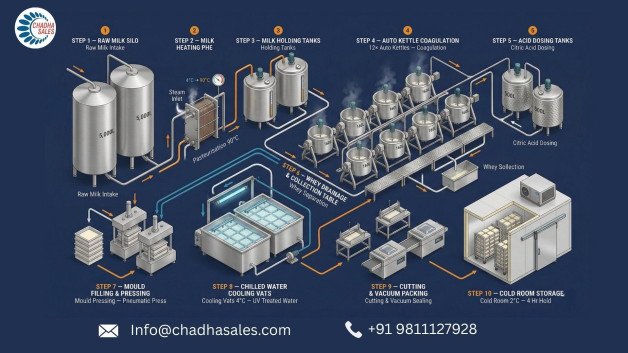
Complete Plant Layout – 10 Step Process
A fully automated paneer line typically follows this end-to-end process flow:
- Raw Milk Silo
- Plate Heat Exchanger (PHE) Heating
- Milk Holding Tanks
- Automatic Kettle Coagulation (multiple units)
- Acid Dosing System
- Whey Drainage
- Mould Filling and Pressing
- Chilled Water Cooling
- Paneer Cutting and Vacuum Packaging
- Cold Room Storage (2°C)
This integrated system ensures high throughput, minimal manual handling, and improved hygiene control.
The Numbers That Matter
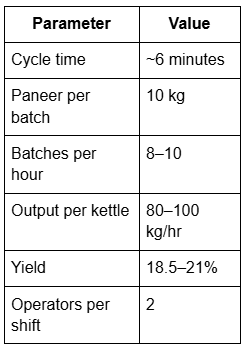
A single 160-litre automatic kettle operating on a 6-minute cycle produces approximately 10 kg of paneer per batch.
Typical Performance
Example Production
With two kettles operating in a shift, production can reach:
≈ 2.5 tonnes of paneer per shift
Return on Investment
The biggest financial advantage of automatic kettles comes from higher yield and milk savings.
Even a 1% improvement in yield has a significant impact at industrial scale.
Example: 5 MTPD Paneer Plant
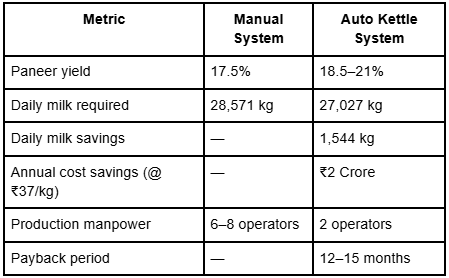
Consistent coagulation temperature and precise acid dosing are the two factors that push paneer yield above 18%, and automatic kettles ensure both remain perfectly controlled.
Key Features of Our Auto Kettle System
PLC and HMI Control
Multiple recipes stored and recalled at the touch of a screen. Every process variable (milk volume, coagulant dose, mix time, tilt sequence) is programmed.
Load-Cell Mounted Design
Each kettle sits on precision load cells for gravimetric milk dosing. No flow meters to calibrate because the system knows exactly what is in the vessel at all times.
Pneumatic Tilting
Smooth, repeatable tilt action drains curd uniformly into molds with zero manual handling. Reduces curd breakage and cross-contamination risk simultaneously.
Food-Grade SS-304 Construction
All product-contact surfaces are mirror-polished SS-304, with actuated valves for milk and coagulant inlets — hygienic, CIP-compatible, and built to last.
Insulated Coagulant Tanks
Heated, jacketed coagulant dosing tanks maintain the acid solution at the ideal temperature for maximum curd quality and consistent yield batch after batch.
Seamless Line Integration
Auto kettles integrate directly with upstream PHE/buffer tanks and downstream mold conveyors, pressing systems, and packaging which ensures no bottlenecks.
Hygiene, Shelf Life and Export Standards
One of the most underrated benefits of automation is elimination of human touch during the coagulation and curd-transfer stages. In manual lines, every operator contact is a potential contamination event — the leading cause of short shelf life in fresh paneer. With auto kettles and closed piping from the PHE to the mold, the product moves in a sealed, sanitisable pathway.
For dairies targeting modern retail, e-commerce, or export markets, this hygiene profile will make all the differene. Combined with nylon micro-slitted molds (which eliminate the traditional muslin cloth, another major contamination vector), achievable shelf lives rise significantly over conventional production.
Scalable from 1 MTPD to 10+ MTPD
The auto kettle architecture is inherently modular. Our designs range from single-kettle semi-automatic upgrades (ideal for existing dairies looking to boost yield and reduce manpower) all the way to six-kettle fully automatic lines producing 10+ metric tons of paneer per day across three shifts.
Importantly, this technology is not just for greenfield projects. Several of our clients have retrofitted auto kettles into existing facilities — retaining their current plate heat exchangers, chilling systems, and presses — and recovered their investment within 12–15 months purely through milk savings.
Watch the Process in Action
See the complete automated paneer production process — from milk intake and coagulation to pressing, cooling, cutting, and vacuum packing — in our plant walkthrough video.
Ready to Upgrade Your Paneer Line?
Our engineering team provides:
- Site-specific feasibility studies
- Production layout drawings
- Detailed ROI projections
Contact us to explore how automation can improve your paneer production efficiency.
✉ info@chadhasales.com
Website – https://chadhasales.com/
Chadha Sales Private Limited | New Delhi – 110054
New Delhi – 110054 | +91-11-2392 2290 | info@chadhasales.com