
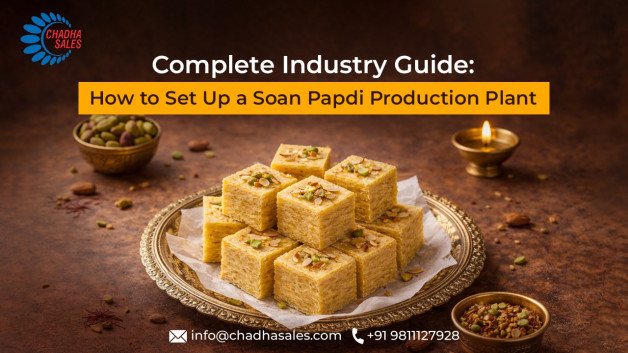
A practical guide covering the production process, essential equipment, plant layout, and compliance requirements for setting up a modern Soan Papdi manufacturing unit — at any scale.
Why Soan Papdi Is a Smart Business Opportunity
Soan Papdi is among India’s most popular traditional sweets — enjoyed year-round and consumed in massive quantities during festivals like Diwali, Rakhi, and the wedding season. Its distinctive flaky, melt-in-the-mouth texture has also earned it a growing fanbase in export markets across the Middle East, Southeast Asia, and the Western Indian diaspora. For food entrepreneurs and established sweet manufacturers, setting up a dedicated Soan Papdi production line is a compelling opportunity with strong margins and scalable operations.
The Art Behind Soan Papdi
Bite into a piece of Soan Papdi and it just disappears — no chewing needed, it’s gone. That magic comes from one thing: the pull.
Making it starts with roasting gram flour in ghee. You go slow, watching the colour shift and breathing in that smell that tells you it’s ready. The sugar syrup is happening at the same time — and this is where experience counts more than any recipe. There’s a moment when the syrup is just right, and if you’ve made Soan Papdi long enough, you know it when you see it. Miss that window and the batch is off.
The two go together while still warm. And then the real work begins.
Stretching. The warm mixture gets pulled, folded, pulled again. Your arms learn the motion before your brain does. Every pull draws out finer threads, layering them one over another until you’ve got something that looks almost too delicate to hold. That’s the strand structure — and that’s what makes Soan Papdi what it is.
Factories now use machines with mechanical arms to do the same job, handling bigger volumes without losing too much of that consistency. But here’s the thing — every producer does it a little differently. Their own flour ratios, their own temperature habits, their own way of finishing the product. A standard machine doesn’t account for any of that. Equipment that’s built around how a specific maker actually works? That’s a different story entirely.
For Any Query, Please Fill Out the Form Below
| Every Manufacturer’s Process is Unique
While the core steps remain the same, every sweet manufacturer has their own recipe ratios, temperature preferences, stretching techniques, and finishing styles. That’s why we design customised solutions tailored to your specific product, capacity, and facility — not one-size-fits-all packages. |
Production Workflow: Step by Step
A well-designed production line follows a sequential flow where timing between stages is critical. The sugar syrup must be at the right temperature when it meets the roasted besan, and stretching must begin before the mixture cools.
1. PREPARATION Sifting & Weighing
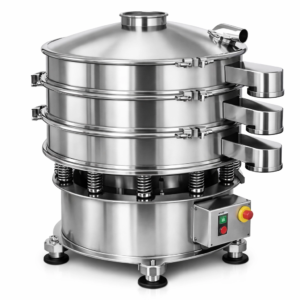
All dry ingredients — gram flour, sugar, and additives — are sifted through a vibro sifter to remove impurities, lumps, and foreign particles. Accurate weighing ensures batch-to-batch consistency.

2. ROASTING Besan Roasting in Ghee
Gram flour is slow-roasted in ghee using a kettle with continuous stirring. Temperature and colour are monitored carefully — the flour must reach a golden-brown stage with a distinct nutty aroma.
3. SYRUP MAKING Sugar Syrup Preparation
 3. SYRUP MAKING Sugar Syrup Preparation
Sugar is dissolved in water and boiled to a specific thread consistency. Temperature control is critical — even a few degrees off can affect the final texture of the product.
4. MIXING Combining Ingredients in the Roasting Kettle
 4. MIXING Combining Ingredients in the Roasting Kettle
The hot syrup is poured directly into the roasting kettle containing the roasted besan, and cardamom, nuts, and flavouring are folded in. This eliminates the need for a separate mixer.
5. CORE PROCESS Stretching / Pulling
This is the heart of Soan Papdi production. The warm mixture is repeatedly pulled and folded — either by hand or using a stretching machine — to create hundreds of fine, layered strands.
6. FORMING Cooling & Sheeting
 6. FORMING Cooling & Sheeting
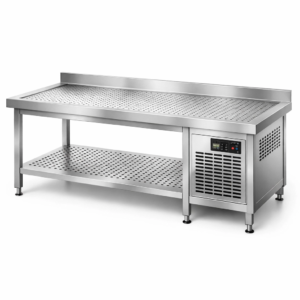
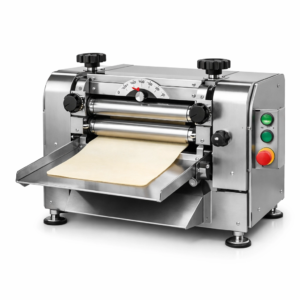
The stretched mass is transferred to a cooling surface where it firms up, then flattened into uniform slabs of desired thickness using rollers or a sheeting setup.
7. FINISHING Cutting, Dusting & Packing
The cooled slab is cut into uniform pieces, dusted with powdered sugar, and packed in food-grade packaging — ready for branding and distribution.
PRODUCTION FLOW AT A GLANCE
 PRODUCTION FLOW AT A GLANCE
Essential Equipment
The exact configuration depends on your target capacity, automation level, and budget. However, most production lines share these core machines:
🔍 Vibro Sifter
Removes impurities from dry ingredients. SS construction
🍳 Roasting Kettle
Tilting or fixed, gas/electric. For roasting and mixing in one vessel.
🧫 Sugar Syrup Kettle
Precision boiling with temperature control and stirrer.
⭐ Stretching Machine
Core machine. Semi-auto or fully automatic variants available.
❄ SS Cooling Table
Controlled cooling before sheeting. Various sizes available.
📐 Sheeting / Rolling
Uniform slab thickness with adjustable roller gap.
✂ Cutting Machine
Manual to fully automatic. Adjustable piece dimensions.
💨 Air Compressor
Powers pneumatic stretching machines. Capacity varies by setup.
Semi-Automatic vs. Fully Automatic?
The right automation level depends on your production targets, labour availability, and budget. We help you evaluate the options and recommend the best fit — from entry-level setups for small sweet shops to high-capacity industrial lines.
Plant Layout & Space Planning
A well-planned factory layout ensures smooth production flow, meets food safety regulations, and allows future expansion. Key zones include raw material storage, a preparation area (sifting, weighing, roasting) with proper ventilation, the core production area (mixing, stretching, cooling), a finishing zone (sheeting, cutting, dusting), a separate packaging area, and utility spaces for compressor, electrical panels, and hygiene facilities.
Space requirements vary significantly by capacity. A small setup (up to 50 kg/hr) can work within 800–1,000 sq ft, while a mid-scale line (100–200 kg/hr) typically needs 1,800–2,500 sq ft. Industrial setups require 5,000+ sq ft. We help with factory layout planning tailored to your available space.
| Space Varies by Capacity
From 800 sq ft for a small sweet shop setup to 5,000+ sq ft for industrial production — we help you plan the right layout for your available space and future growth. |
Compliance Essentials
Running a food manufacturing unit in India requires meeting several regulatory standards. Getting these right from the start saves time, money, and legal headaches.
✓ FSSAI License — Mandatory for all food manufacturing businesses
✓ Food-grade SS 304 contact surfaces on all equipment
✓ Good Manufacturing Practices (GMP) with documented SOPs
✓ Epoxy or food-grade flooring with proper drainage
✓ Regular pest control and water quality testing
✓ Pollution Control Board NOC where applicable
Choosing the Right Equipment Partner
Your equipment supplier is a long-term partner. Look for experience specifically in Indian sweets and confectionery equipment, transparent terms with clear delivery timelines and warranty, installation support and operator training, and responsive after-sales service with spare parts availability. A good partner will also help with plant layout, utility planning, and FSSAI compliance guidance.
| Why Manufacturers Trust Us
We work with a curated network of India’s most reliable food processing equipment manufacturers. Whether you need a single machine or a complete turnkey line, we help you get the right equipment at the right price — with guaranteed quality and support. |
Ready to Set Up Your Soan Papdi Plant?
Get in touch for a free consultation. We’ll help you plan the right production line for your goals.
☎ +91-11-2392 2290 / 2392 0100
✉ info@chadhasales.com
Webiste – https://chadhasales.com/
Chadha Sales Private Limited | New Delhi – 110054
New Delhi – 110054 | +91-11-2392 2290 | info@chadhasales.comPage